
In This Guide
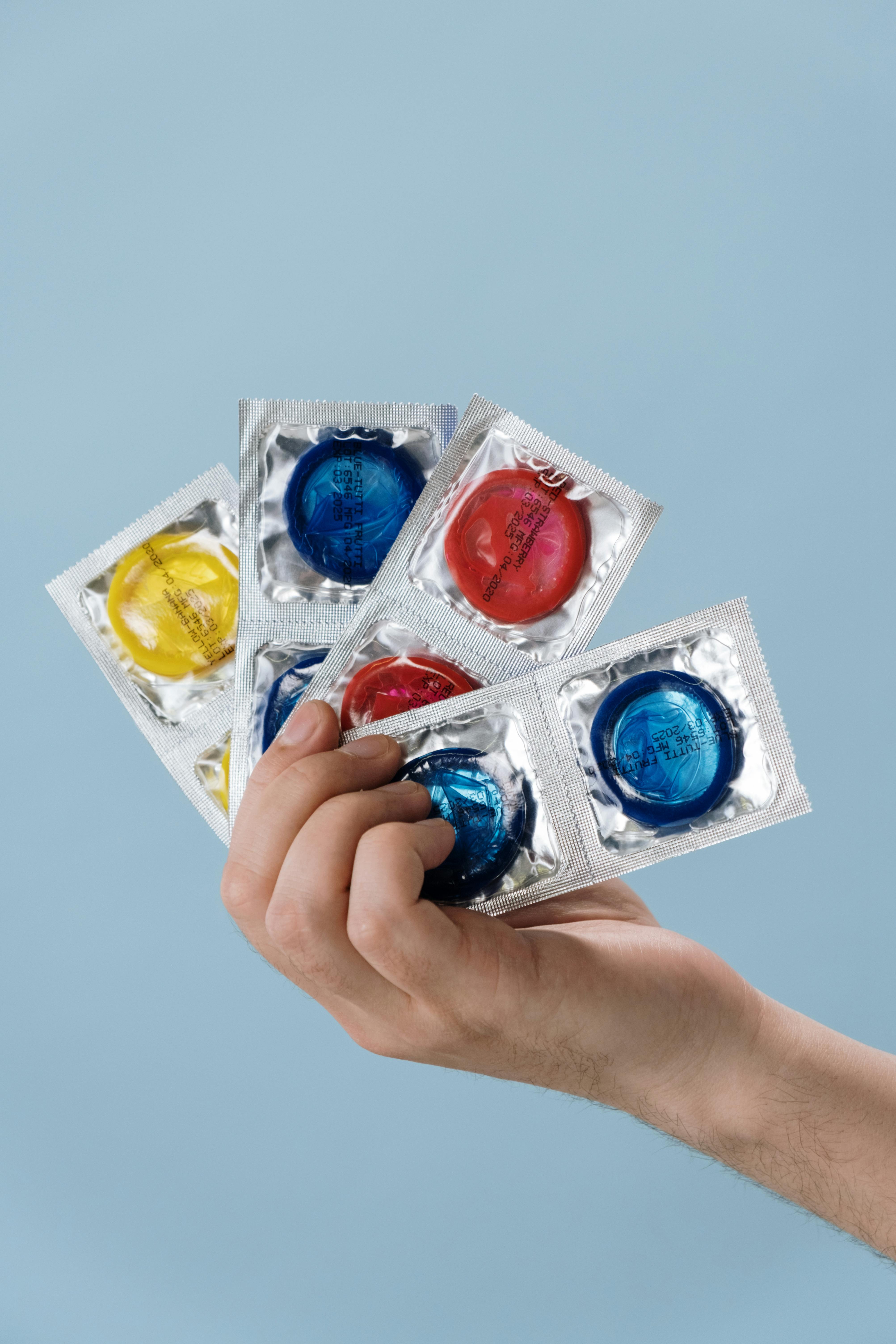
A condom is a thin sheath, usually made of latex but also available in polyisoprene, polyurethane, or natural lambskin, worn during sex to prevent pregnancy and reduce the risk of sexually transmitted infections. The external (male) condom is rolled onto an erect penis before sex; the internal (female) condom is inserted into the vagina or rectum. Condoms are the most widely used barrier method of contraception worldwide and the only contraceptive method that also protects against STIs. This guide covers what condoms are, how they work, and their long and complicated history.
How a Condom Works
A condom is a physical barrier. The external condom captures ejaculate and prevents sperm from entering the vagina; both external and internal condoms reduce fluid exchange between partners, which reduces the transmission of STIs that spread through semen, vaginal fluid, and blood. The barrier function depends on the condom remaining intact throughout sex and being removed correctly without spillage.
For pregnancy prevention, external condoms are about 98 percent effective with perfect use and 87 percent effective with typical use. For STI prevention, effectiveness varies by infection type. Fluid-borne STIs (HIV, gonorrhea, chlamydia, hepatitis B) are very effectively blocked. Skin-to-skin STIs (herpes, HPV, syphilis) are partially blocked because the condom does not cover every area of contact. See How Effective Are Condoms? and Do Condoms Prevent STDs & STIs?.
The Two Types
External (male) condoms
Worn over the penis. The vast majority of condoms sold and used worldwide. Available in a wide range of sizes, materials, textures, and features. Most are latex; alternatives include polyisoprene (like SKYN), polyurethane, and lambskin.
Internal (female) condoms
Inserted into the vagina or rectum before sex, with a flexible ring at the closed end (inside) and an outer ring that sits outside. The current widely available product is the FC2, made of synthetic nitrile. Less commonly used than external condoms but offer some advantages including pre-sex insertion and partner-independence. See Female (Internal) Condoms: The Complete Guide and How to Use a Female Condom.
A Brief History
Ancient and pre-modern uses
Records of condom-like barriers go back thousands of years. Ancient Egyptians may have used linen sheaths around 1000 BCE, though the evidence is debated. Ancient Roman and Chinese writings describe similar devices. The first documented modern condoms appeared in the 1500s, when Italian physician Gabriele Falloppio described linen sheaths soaked in chemicals to protect against syphilis.
Animal-membrane condoms
From the 1600s through the 1800s, condoms were typically made of animal intestine (sheep, lamb, or goat cecum). These were expensive, hand-made, and reusable in some cultures. Lambskin condoms today are descendants of this tradition. They predate latex by centuries.
The vulcanized rubber era
Charles Goodyear's vulcanization of rubber in 1839 made the modern condom possible. The first rubber condoms appeared in the 1850s. They were thick (often called "raincoats"), reusable, and sized to fit only the head and shaft (not rolled down to the base). The Comstock Act of 1873 made condom advertising illegal in the United States for decades.
Latex and disposable condoms
Latex was developed in the 1920s, and the first disposable latex condoms came in 1930. They were thinner, cheaper, and dramatically more effective than rubber. Trojan (founded as Youngs Rubber Company in 1916) became one of the first major U.S. brands.
Birth control politics
Condom legality and availability shifted with broader contraception politics throughout the 20th century. The Comstock Act was relaxed in the 1930s. In 1965, Griswold v. Connecticut established a constitutional right to contraception for married couples; in 1972, Eisenstadt v. Baird extended this to single people. Vending machine condom sales became widespread in the 1970s and 1980s.
The HIV/AIDS era
The HIV/AIDS epidemic in the 1980s and 1990s transformed condom use from primarily contraception to also being central to public health. U.S. and global public health campaigns promoted condoms aggressively. Free condom distribution expanded through clinics, schools, and community organizations. Brands like Durex and ONE grew substantially in this era.
Modern era
Since the 2000s, the category has expanded into specialty options: ultra-thin (Kimono, Crown), non-latex (SKYN, Supra Bareskin), custom-fit (MyONE), and engineered (LELO HEX). Online retail has made the full category accessible, including styles not commonly stocked in retail stores.
Common Materials Today
- Latex (natural rubber): 95+ percent of condoms sold. Cheapest, strongest track record, widest variety.
- Polyisoprene (synthetic rubber): for users with latex allergies and those who prefer softer feel. See SKYN Condoms: Full Guide.
- Polyurethane (plastic): thinner, better heat transfer, oil-lube compatible.
- Lambskin (sheep cecum membrane): natural, very thin, does not protect against STIs.
See Polyisoprene vs Polyurethane vs Lambskin for the detailed material comparison.
Why Condoms Are Still Important
Despite the availability of more effective contraceptives (IUDs, implants, the pill), condoms remain essential for three reasons:
- STI prevention: no other contraceptive method offers this dual protection.
- No prescription required: condoms are over the counter, accessible to anyone of any age.
- No hormones, no devices: useful for users who cannot or do not want to use hormonal contraception.
Condom Use Globally
The United Nations Population Fund estimates that condoms are used in 5 to 10 percent of all heterosexual acts of intercourse globally, with significant variation by country and culture. Use is generally higher in younger populations and in regions with active public health programs. Brazil, France, and the UK have particularly high condom-use rates among young adults.
Frequently Asked Questions
Who invented the condom?
No single inventor. The modern latex condom is an evolution of barrier methods going back thousands of years. Charles Goodyear's vulcanization of rubber in 1839 enabled the first mass-produced rubber condoms in the 1850s; latex condoms followed in 1930.
What is a condom called scientifically?
"Condom" is the standard medical term. In academic and public health literature, "external condom" and "internal condom" are now preferred over "male condom" and "female condom" because they describe the device rather than assuming gender.
Why is it called a condom?
The etymology is disputed. Theories include derivation from the Latin "condus" (receptacle), from the personal name of a 17th-century English doctor (no contemporary evidence), or from various French and Italian sources. The English word was in use by the early 1700s.
What is the most common condom in the world?
Durex by global volume; Trojan by U.S. volume. Both are latex condoms with multiple variants.
Are condoms environmentally friendly?
Latex is biodegradable in principle but takes years to break down because of the additives used in manufacturing. Polyurethane and polyisoprene are not biodegradable. Lambskin is fully biodegradable. None of these should be flushed; throw them in the trash.
Shop the Full Condom Range